Workplace Stress Is Already Costing Czech Companies. Most Just Haven’t Named It Yet.
Mavie
Editorial Team
Article highlights
Workplace stress in the Czech Republic is already a cost, not just a risk
- 76% of employees work through exhaustion instead of staying home.
- 62% say stress affects their performance at least moderately.
- Sick leave from mental illness alone cost the economy an estimated CZK 16 billion in 2024.
The problem stays invisible because almost nobody discusses it at work
- 72% have not discussed their mental health at work in the past year.
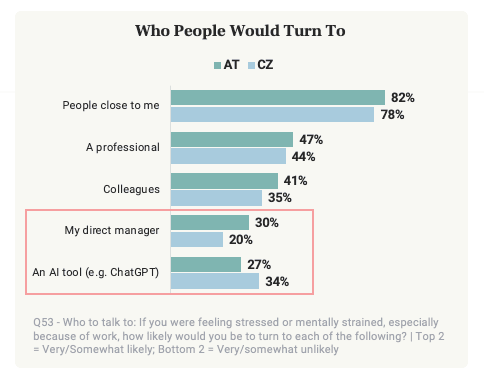
- Only 20% would turn to their direct manager about work-related stress.
- 34% would rather talk to an AI tool than their manager, especially women.
An Employee Assistance Program (EAP) directly addresses these barriers
- It is confidential and sits outside the line-management relationship entirely.
- It is free and voluntary, with no diagnosis or referral required to access it.
- In Austria, visible leadership use of an EAP cut sick days per employee from 8.6 to 7.5.
Three out of four employees in the Czech Republic go to work exhausted rather than stay home.¹ Not occasionally — as a default. Most of them do it for financial reasons, and nearly half simply have no one to cover for them.¹ None of this shows up as sick leave. It shows up as a slow leak in performance that most companies have no name for, let alone a line item for. The Mavie Stress Study 2026 surveyed 394 employees in the Czech Republic to find out exactly where that leak starts — and what closes it.
Mental Health Looks Fine on a Form. The Numbers Tell a Different Story.
Ask Czech employees to rate their own mental health, and the picture looks reassuring: 48% call it good or very good, only 12% call it poor.¹ Ask a more specific question, and that picture changes fast. 61% say they feel stressed often or very often, and for 40% of them, it has been getting worse over the past year.¹ One in four women report reaching a point this past year where they mentally could not go on, and they reported this several times, not once.¹
This is not a contradiction. It is what happens when a self-rating question and a frequency question measure two different things: how someone wants to see themselves, and what is actually happening week to week. For an employer, the second number is the one that predicts turnover, errors, and burnout. The first one is the one that shows up in an engagement survey.
Work Is the Number One Stressor in the Czech Republic — and It Is a Specific Kind of Pressure
Czech employees rank work as their single biggest source of stress, ahead of financial matters, family, and their own health.¹ Narrow it down to what inside work actually causes it, and a clear pattern emerges: deadline and performance pressure comes first, followed by carrying too much responsibility or simply feeling overwhelmed, then conflict with colleagues or superiors, then unclear or contradictory expectations from above.¹
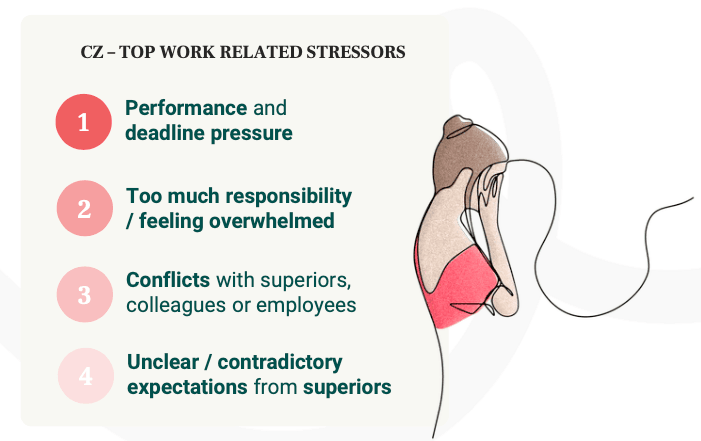
That ordering matters for where a company should intervene. Deadline pressure and unclear expectations are not personality problems that require a wellness app. They are management and workload problems that happen to land on an individual’s nervous system first.
The Response Isn’t Sick Leave. It’s Showing Up Anyway.
76% of Czech employees say they go to work even when exhausted.¹ Financial necessity is the most common reason, cited by 69%, nearly double the share who say the same in neighboring Austria.¹ Close behind: 48% say there is simply no one to cover for them if they stay home.¹ A third say it is fear of job loss.¹
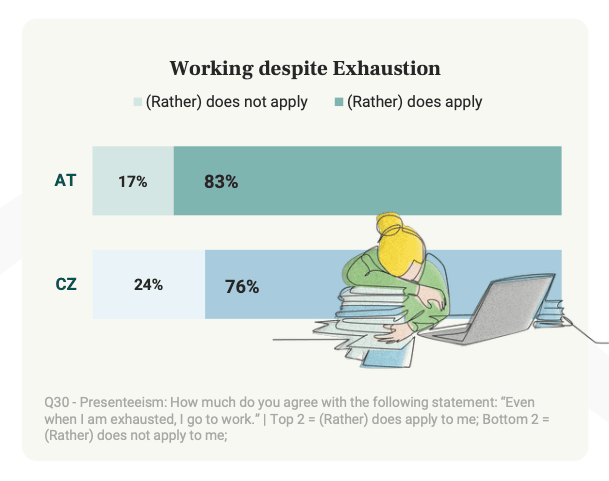
This is presenteeism, and it is already measurable inside performance numbers most companies already collect. 62% of Czech employees say stress affects their work performance at least moderately, and one in five describe the impact as strong or very strong.¹ Globally, research using the WHO’s productivity questionnaire puts the average cost of this effect at 57.5 lost working days per employee per year — nearly three full working months of reduced output, while the person is still at their desk.² Sick leave is not even part of that number.
What This Already Costs
In 2024, sick leave linked to mental illness alone cost the Czech economy an estimated CZK 16 billion, roughly €670 million.³ That figure covers absence. It does not cover the presenteeism loss described above, which research consistently finds is several times larger than the cost of absence itself.²
The pattern is not unique to the Czech Republic. Across the EU and the UK, the total cost of mental ill-health is estimated at more than €600 billion a year, over 4% of GDP.⁴ Globally, the World Health Organization and the International Labour Organization estimate that depression and anxiety alone cost the world economy close to US$1 trillion a year through 12 billion lost working days.⁵ Czech employers are not managing a local anomaly. They are managing a local instance of a cost that every comparable economy is already carrying.
Why This Stays Invisible: Almost Nobody Is Talking About It at Work
72% of Czech employees have not discussed their mental health at work with anyone, colleague or superior, in the past year.¹ That silence is not a sign that nothing is wrong. It is a sign that the people most affected have decided work is not a safe place to say so.
What they would do instead is more telling than the silence itself. Asked who they would actually turn to if work-related stress became hard to manage, only 20% name their direct manager.¹ More Czech employees, 34%, say they would turn to an AI tool like ChatGPT instead, and that gap is especially wide among women.¹ Fear of appearing uncertain or vulnerable in front of a manager is a believable barrier. An algorithm cannot judge anyone’s performance review. It also cannot do anything to actually help.
What an Employee Assistance Program Actually Is
An Employee Assistance Program, or EAP, is a confidential, employer-funded counselling and support service that employees can access voluntarily and free of charge, independent of their line manager or HR department.⁶ A trained counsellor outside the company, reachable by phone, app, or in person, helps with work-related stress, personal difficulties, or anything in between, and nothing discussed is reported back to the employer beyond anonymized usage statistics.⁶
That structure is not incidental. It is the direct answer to the two barriers the data above just described. Employees will not raise a problem with the person who writes their performance review, so an EAP routes them to someone outside that relationship entirely. They would rather talk to an algorithm than risk looking uncertain in front of a colleague, so an EAP offers the same low-threshold, judgment-free access, except with an actual professional on the other end who can do something about the problem.
This is also the point many Czech companies have not yet reached. In more mature markets, an EAP is a standard line in the benefits package, next to health insurance and meal vouchers. In the Czech Republic, the concept is still new enough that most HR teams have never had to explain it to their own leadership. That is not a gap in employee demand. It is a gap in what has been offered.
It Is Not Only an Employee Problem. Leaders Carry It Too.
More than half of Czech employees say they experience their direct manager as visibly stressed often or very often, the same share reported in Austria.¹ The effects travel downward in specific, measurable ways: 26% say they avoid raising topics or giving feedback when their manager is visibly under strain, 24% say they actively try to support or relieve their manager, and 23% say they think more often about changing jobs because of it.¹
None of that is in anyone’s job description. It is also exactly why an EAP works best when it covers leaders as well as staff: a manager who has no low-threshold way to manage their own pressure has no way to stop passing it down the chain, no matter how good their intentions are.
What This Looks Like Once a Company Acts on It
Mavie Work has already run this model with a client in Austria, the premium sports retailer Bründl Sports, and the result is a useful preview of what is possible once a company moves from offering support to employees actually using it. After leadership visibly used the confidential counselling service themselves, not just offered it, sick days per employee fell from 8.6 to 7.5 in a year, a saving of roughly €1.2 million.⁷ Almost one in ten of the company’s 550 employees contacted the service in the first year, and usage kept rising.⁷
The Czech Republic does not yet have its own case study, because this is the market where Mavie Work is introducing the model now. The Austrian result is not a promise of an identical outcome. It is evidence that the mechanism works once a company commits to it past the point of simply listing it in a benefits brochure.
The Starting Point for HR and Leadership
The numbers above describe a cost that Czech companies are already paying, whether or not it appears on a balance sheet: lost performance, quiet turnover risk, and a workforce that has learned not to say anything until it becomes urgent. An Employee Assistance Program does not remove workplace pressure. It gives people a real, confidential place to take it before it turns into a resignation letter or a long-term absence.
For HR teams and leadership in the Czech Republic weighing whether this is worth introducing, the more useful question is not whether employees need support. The data above already answers that. The real question is how much longer the cost of not offering it stays invisible.