Mavie Stress Study 2026: Key findings for Austria
Mavie
Editorial Team
Article highlights
Stress is the norm in Austria, not the exception
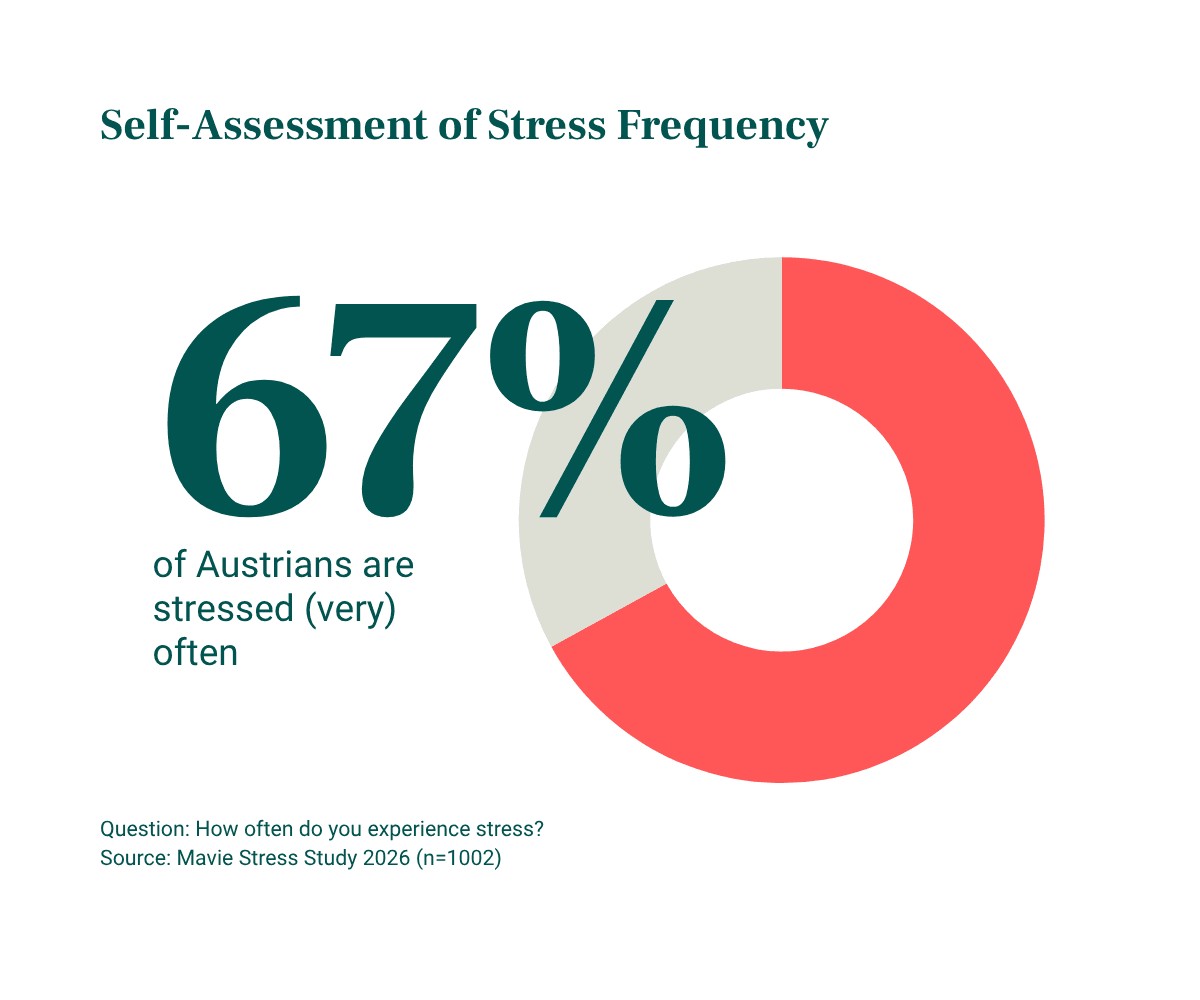
- 67 percent of Austrians report being (very) frequently stressed, and almost 40 percent say it's getting worse.
- Women and female executives report high stress significantly more often than men.
- Among early-career employees with up to three years of tenure, almost three-quarters are affected.
The body pays the price while many keep working
- Exhaustion, sleep problems, and psychological strain top this year's list of stress-related complaints.
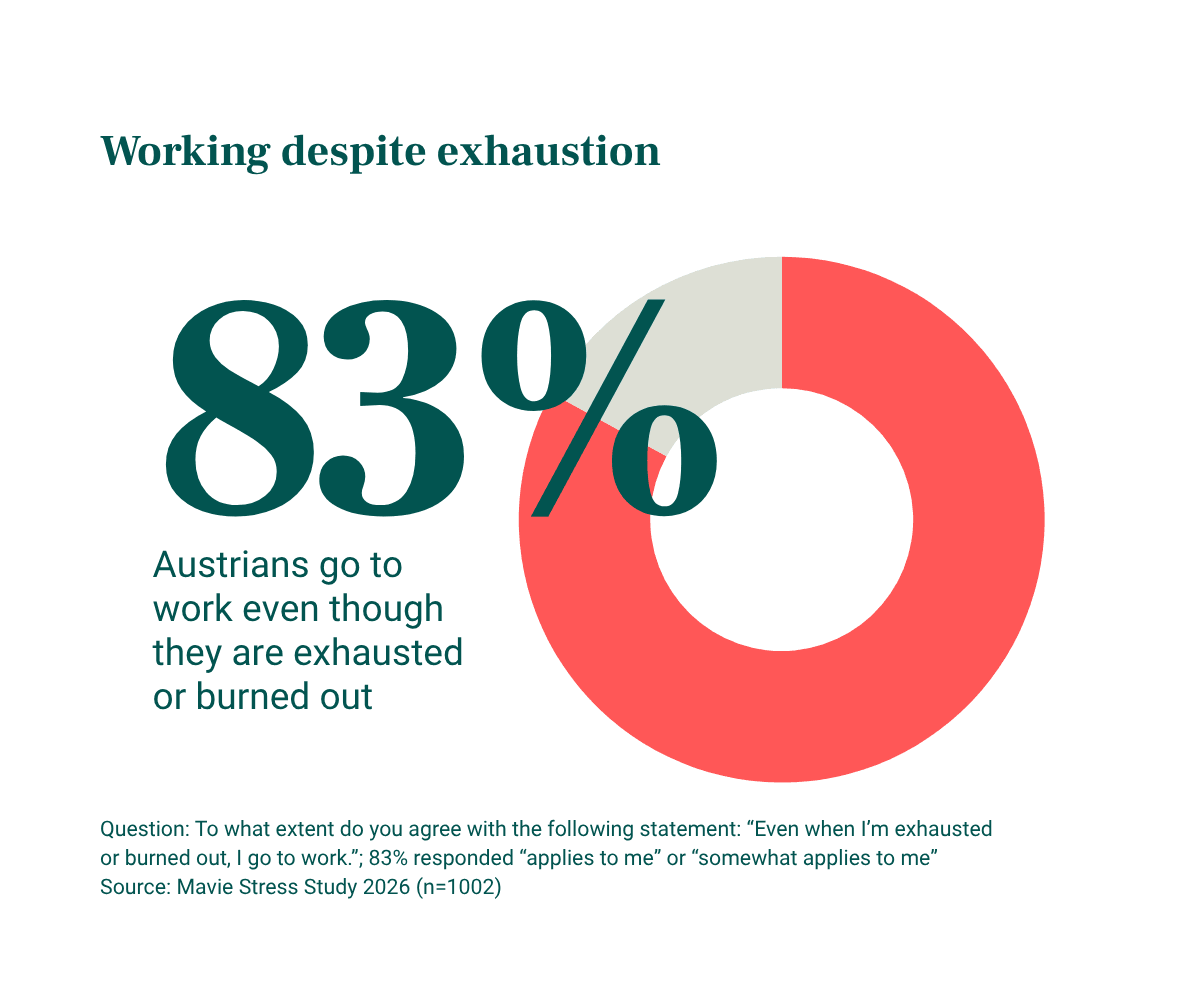
- 83 percent go to work despite exhaustion, and a quarter feel a significant drop in performance as a result.
- Rising stress is clearly linked to worse sleep: 29 percent report (very) poor sleep.
Talking about stress remains difficult
- Only 14 percent seek professional support, down from 21 percent the previous year.
- Three-quarters haven't discussed their mental health with anyone at work in the past year.
- Employees trust their own manager barely more than an AI tool when it comes to psychological strain.
Two out of three people in Austria feel (very) frequently stressed. And 83 percent keep going to work even when they're actually exhausted or burned out. The effects on health and performance are noticeable. But only 14 percent of them seek professional support — often because there are too many barriers to access. These are the key findings of the Mavie Stress Study 2026. This year, for the first time, we surveyed not only Austria (n=1002) but also the Czech Republic (n=394). The numbers paint a picture of a country that looks stable on the surface but is increasingly running on empty underneath. Above all, they show just how little this is actually being talked about.
How stressed is Austria, really?
At first glance, Austrians' mental health looks stable. 43 percent rate it as (very) good, though that's a slight drop from last year's 48 percent. A different picture emerges once you ask about how often people experience stress: 67 percent say they feel (very) frequently stressed, and almost 40 percent say their stress levels have gotten worse over the past one to two years. Stress is no longer a fringe phenomenon — for most of society, it's become a constant companion in everyday life, with effects that are clearly felt.
Women are hit especially hard
The burden is anything but evenly distributed. Women report frequent stress considerably more often than men — 73 percent versus 61 percent. A quarter of women even reached a point last year, more than once, where they felt they couldn't cope mentally any longer. This gap shows up at the leadership level too: 76 percent of female managers report frequent stress, compared with 67 percent of male managers. More than half of women in leadership roles also say their stress levels have risen over the past few years, compared with just over a third of men. Whether this reflects a genuinely higher burden or simply a sharper awareness of it, the clear gap between the genders remains a signal that needs to be taken seriously.
Work remains by far the biggest source of stress
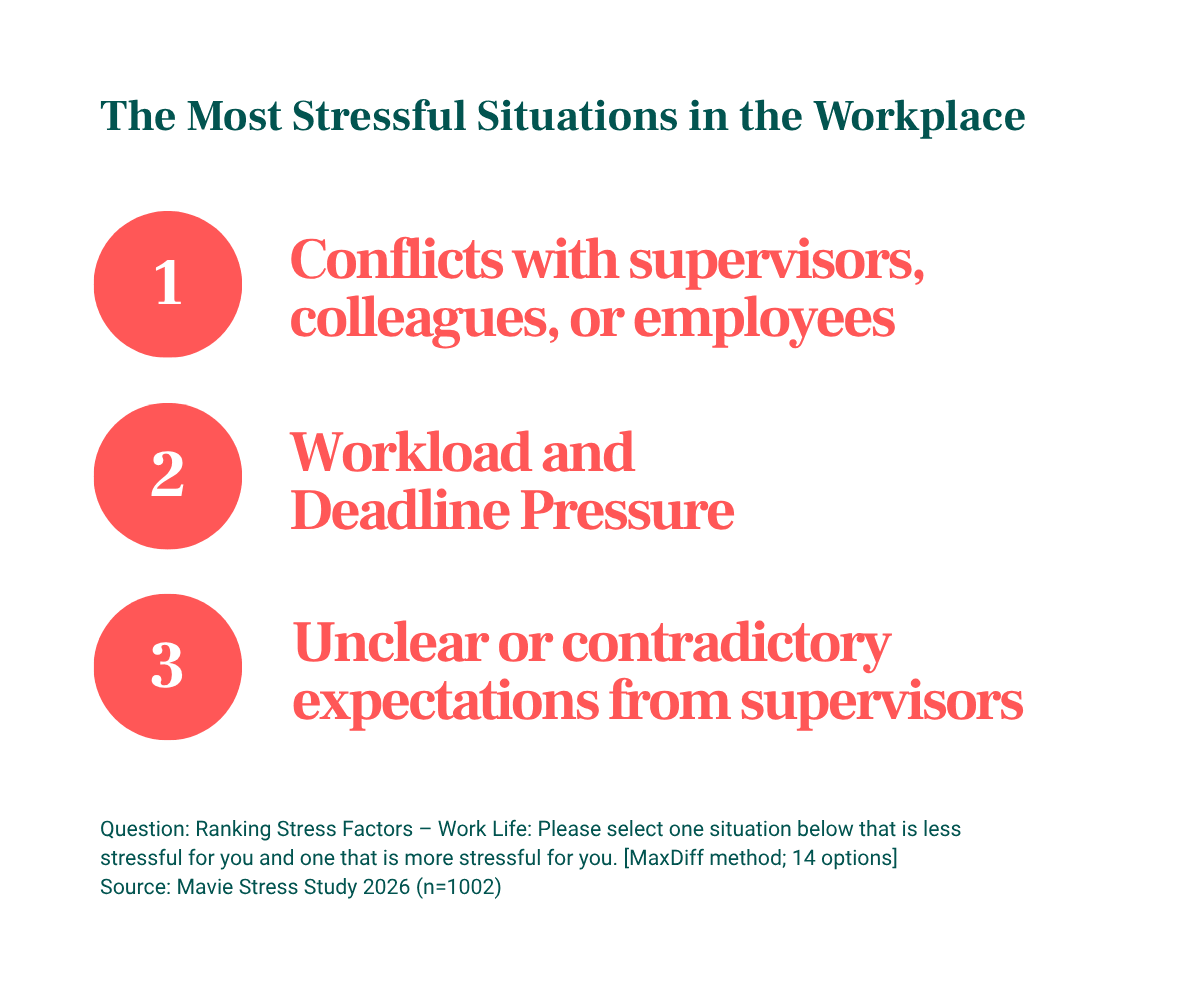
Asked what burdens them most, people in Austria name work first — ahead of financial worries, family issues, and their own health. Within work, three factors stand out as the most stressful: conflicts with managers, colleagues, or direct reports; performance and deadline pressure; and unclear or contradictory expectations from managers. That last point deserves particular attention: unlike deadline pressure or conflict, it's a factor that can be influenced fairly directly — for example, through clearer communication in everyday work.
The body notices first, but many keep working anyway
This year, exhaustion, sleep problems, and psychological strain top the list of complaints respondents link to their stress, ahead of back and neck pain or irritability. The connection to sleep is especially clear: among people with rising stress levels, 29 percent report (very) poor sleep, compared with just 9 percent among those whose stress levels are falling. Even so, 83 percent of people in Austria keep going to work even when they're exhausted. The most common reason given is financial necessity, followed by feeling guilty toward colleagues (more common among women) and not wanting to show weakness (more common among men). The consequences show up not only physically and mentally, but in performance too: 70 percent of respondents feel at least a moderate impact on their performance, and almost a quarter feel a strong or very strong decline. This is exactly where many companies have a blind spot: anyone who only looks at sick-leave numbers is missing the real scale of the problem.
Why so few still talk about it
The most striking finding in this year's Stress Study is how much the silence around psychological strain has deepened. Only 14 percent seek professional support for stress, down from 21 percent in 2025. Open conversation shows the same trend: around three-quarters haven't spoken to anyone at work about their mental health in the past twelve months, a noticeably higher share than the year before.
The main reasons respondents give are fear of negative consequences and uncertainty about whether their manager would even respond helpfully. But above all, they don't want to appear vulnerable in front of their own manager. One detail stands out in particular: when it comes specifically to work-related strain — exactly the kind of issue a manager could directly do something about — respondents rate their manager as only marginally more trustworthy than an AI tool. That's not a sign of low need. It shows just how high the hurdle still is, for many, to even start that first conversation about their own strain.
Michaela Hack, psychosocial counselor at Mavie, puts it into context:
In counseling practice, we mainly see four barriers. Often the hardest hurdle of all is simply admitting to yourself that you need support. On top of that come worries about cost, lack of time — and many people simply don't know where to find professional help.
When leadership itself is under pressure
Part of the explanation lies with leadership itself. More than half of people in Austria experience their own manager as visibly stressed (very) often. And that doesn't stay without consequences for the team: for almost a third, it noticeably reduces their enjoyment of their own work. One in five ends up thinking about changing jobs more often as a result. This also has economic consequences: according to Gallup, "quiet quitting" costs around €9 trillion a year worldwide, roughly 9 percent of global economic output. We look in detail at how strongly stress among managers spreads through entire teams, and what companies can concretely do about it, in a separate article.
What companies can concretely do
When it comes to managing stress, most people in Austria turn to themselves first. Time alone, being active outdoors, and talking with friends or family top the list of strategies people use. Professional support, by contrast, remains the exception. This is exactly where low-threshold offers come in — before exhaustion turns into something more. Mavie Work's Employee Assistance Program offers anonymous, confidential counseling from experienced advisors, with no need to go through one's own manager. Available in person or digitally, around the clock. Scientifically grounded personality analyses, meanwhile, help identify stress patterns early, before they spread across entire teams, supporting a healthy work environment and employees who can perform at their best. And with MavieMe's cortisol test, people can, for the first time, get an objective read on their own stress level, including a doctor's commentary to help interpret the results.